
Right of Withdrawal in E-commerce 2026: What’s Changing Under the New Distance Selling Law
June 19 2026 is approaching: is your website ready for the mandatory withdrawal button requirement? Legal framework, implications, and a compliance checklist.

The right of withdrawal is a fundamental consumer right in France and across Europe: when purchasing online, customers generally have 14 days to change their mind without having to provide any justification. This principle has existed since the 2011 European Consumer Rights Directive and is codified in French law under Articles L221-18 to L221-28 of the French Consumer Code.
Until now, retailers mainly had to inform their customers of the existence of this right, usually through their terms and conditions. As of June 19, 2026, this is no longer sufficient. The Ordinance No. 2026-3 of January 5, 2026, adopted to implement Directive (EU) 2023/2673, now imposes a new concrete requirement: to implement a dedicated online feature, accessible directly from the purchase interface, allowing consumers to exercise their right of withdrawal in just a few clicks.
This article outlines the new requirements, operational implications, and concrete actions to implement before the deadline.
1. The right of withdrawal: current framework
Who can benefit from it?
The right of withdrawal applies to any consumer (a natural person acting outside a professional context) who enters into a distance contract (internet, phone, mail) with a professional. It does not apply to transactions between professionals (B2B).
The 14-day period
Consumers have 14 calendar days from the day after receiving the goods (or from contract conclusion for services) to exercise their right, without justification. If the deadline falls on a Saturday, Sunday, or public holiday, it is extended to the next working day.
Special case: if the seller has not properly informed the consumer of this right, the withdrawal period is extended by an additional 12 months.
Exceptions to the right of withdrawal
Certain products and services are excluded. Retailers must clearly identify them in their terms and conditions:
- Customized or made-to-order products (e.g., tailored clothing, custom-sized furniture)
- Goods likely to deteriorate or expire quickly (fresh food, unsealed cosmetics)
- Audio, video, or software products unsealed after delivery
- Newspapers, periodicals, and magazines
- Services fully performed before the end of the withdrawal period (with explicit consumer consent)
- Contracts concluded at public auctions
Watchpoint for fashion and beauty: cosmetics are only excluded if unsealed. An intact product in its original packaging remains eligible. Brands must therefore manage sampling abuse and resale risks.
Current seller obligations
Before purchase, the seller must inform the consumer:
- Whether the right of withdrawal exists or not
- The conditions, deadlines, and procedures for exercising it
- Whether return costs are borne by the consumer or the seller
- The standard withdrawal form (annex to the Consumer Code)
After receiving the returned product, the seller must refund the consumer within 14 days, using the same payment method (unless explicitly agreed otherwise).
2. What changes on June 19, 2026: mandatory withdrawal button/link
The January 5, 2026 ordinance introduces a concrete new requirement: any online seller must implement a dedicated feature allowing consumers to exercise their withdrawal right directly from the purchase interface.
Mandatory characteristics
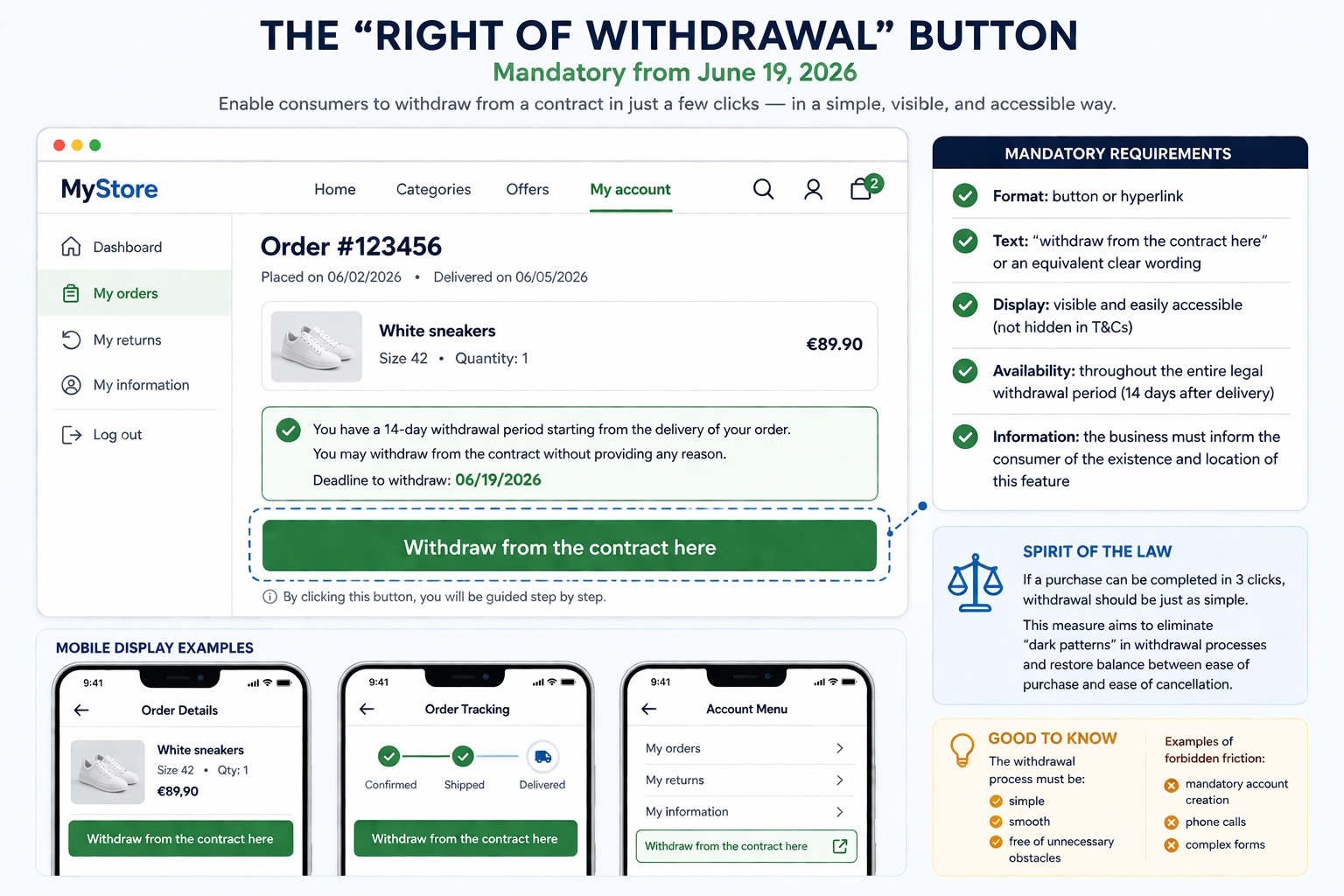
The feature must:
- Take the form of a button or hyperlink
- Be labeled “withdraw from the contract here” or an equivalent clear wording
- Be visible and easily accessible (not hidden in T&Cs)
- Remain available throughout the legal withdrawal period (14 days after delivery)
- Be clearly communicated to the consumer
The principle is straightforward: if a purchase can be completed in a few clicks, withdrawal must be equally simple. Authorities have identified that many websites deliberately made withdrawal difficult. This measure targets those “dark patterns.”
Where to integrate the feature
It must be accessible through customer touchpoints used to manage orders, for example:
- In the customer account (“Cancel my order” button in order history)
- Via a direct link in emails (order confirmation or delivery emails)
- On a dedicated page accessible from the website
- Through a chatbot or online assistant
Access must be immediate, simple, and not require contacting support.
Pre-contractual information updates
Merchants must inform customers, before purchase, of the existence and location of this feature. This requires updating terms and purchase flows.
CMS compliance challenges
Most CMS platforms (Shopify, PrestaShop, Magento) do not natively provide compliant features.
Two options:
- Build a custom solution (heavy, tech-dependent)
- Use third-party apps/modules (faster but integration-dependent)
A critical point: a simple button is not sufficient. The feature must:
- Be linked to the order
- Respect the 14-day post-delivery window
- Automatically trigger returns, refunds, and notifications
Without full integration, you remain non-compliant—even if the button is visible.
Marketplace impact
Marketplaces are also affected: if the transaction occurs on a platform, the platform must provide the withdrawal functionality, coordinated with third-party sellers.
3. Non-compliance: immediate financial and operational impact
Non-compliance has direct consequences:
- Administrative fines (DGCCRF): €15,000 for sole proprietorships (EI, EIRL, micro-entrepreneurs) and €75,000 for companies (SARL, SA, SAS, etc.), with possible publication of the sanction (immediate reputational impact).
- Extension of the withdrawal period: up to 12 months instead of 14 days if the right is not properly respected, pursuant to Article L221-20 of the French Consumer Code → mechanical increase in late returns and refunds.
- Direct revenue loss: increased refunds outside normal periods
- Legal risks and disputes: mandatory refunds, potential damages, increased support workload
- Risk of misleading commercial practices classification: additional sanctions and scrutiny
In practice, the main risk is loss of control over returns, which can quickly erode margins and customer satisfaction.
4. Operational implications for retailers
E-commerce & product teams
- Audit purchase and account interfaces
- Implement or update the withdrawal button/link
- Update post-purchase emails with a visible link
- Ensure availability during the 14 days after delivery (not order date)
Operations & logistics teams
- Anticipate increased withdrawal rates (+10–20%)
- Automate return flows (labels, notifications to logistics partners)
- Ensure refund SLAs (14 days after return) are maintained at scale
- For omnichannel: align online withdrawal with in-store returns
Legal & compliance teams
- Update T&Cs and return policies with explicit mention of the feature
- Verify excluded products list and ensure proper display pre-purchase
- Train customer support to avoid inconsistent responses
Key risks for fashion & beauty
These sectors already have high withdrawal rates (25–40% in fashion). Simplifying the process without addressing root causes (sizing, product descriptions, visuals) will likely reduce margins significantly.
5. Timeline and penalties
6. Compliance checklist before June 19, 2026
7. Post-purchase: a concrete lever to reduce withdrawal
The right of withdrawal is only the legal aspect of a broader issue: the quality of the post-purchase experience. Brands that invest in proactive communication after the order—such as real-time delivery notifications, branded tracking pages, and anomaly alerts—consistently see a decrease in withdrawal rates.
In practice, a large share of withdrawals is not driven by a genuine change of mind. They result from anxiety caused by a lack of information about delivery status. A customer who does not know where their parcel is after four days is more likely to withdraw or open a dispute than a customer who is informed in real time.
Key data point: according to Shipup data across more than 81,7 million racked parcels, proactive communication on delivery milestones reduces WISMO (“Where Is My Order”) tickets by 67% and improves NPS by an average of 30 points. Brands that reduce post-purchase anxiety systematically reduce their withdrawal rates.
FAQ
Is the withdrawal period 7 or 14 days?
In e-commerce, the general rule is 14 days. This applies to most distance purchases, particularly online.
When does the withdrawal period start?
For a product, the period starts the day after delivery. For a service, it starts the day after the contract is concluded. In the case of multiple shipments, it starts upon receipt of the last parcel.
Where should the withdrawal feature be integrated?
The withdrawal functionality must be integrated directly into the customer touchpoints used to manage orders, such as the customer account, confirmation or delivery emails, or a dedicated page accessible from the website. Access must be simple, visible, and immediate.
When does the right of withdrawal not apply?
It does not apply to certain specific products and services, including customized goods, perishable items, unsealed content, or services already fully performed with the customer’s consent.
Can the seller offer store credit instead of a refund?
In principle, the seller must issue a refund. Store credit can only be offered if the customer explicitly agrees.
Frequently Asked Questions

.jpeg)

Since 2023, Joseph Thurston has been responsible for content creation at Shipup by ZigZag. He designs high value-added and directly actionable resources for brands that sell online, in order to help them improve their post-purchase experience and transform delivery into a driver of loyalty and growth.


.png)
