
E-commerce returns in France: Key figures retailers need to know in 2026
Discover the key figures for e-commerce returns in France in 2026, new consumer habits, and priorities for retailers.
Taking time off to receive a package, turning the living room into a fitting room, and making purchases with the intention of returning them: e-commerce is no longer just changing how the French shop. It is reorganizing their daily lives.
In 2026, returns are no longer an exception at the end of the customer journey. They influence brand choice, purchasing decisions, order profitability, and future loyalty.
This shift is particularly evident among younger consumers. According to a 2026 study conducted by Sapio Research for Shipup by ZigZag, 44% of Gen Z members say they have already adopted at least one planned buy-and-return behavior, compared to only 9% of Baby Boomers. For this generation, ordering, trying on at home, and then returning is no longer a glitch in the process: it is the process.
Retailers must therefore adapt to a dual reality: consumers who are more comfortable with returns, but also much more demanding when faced with delivery friction, opaque policies, and slow refunds.
Key figures to remember
Source: study conducted in May 2026 by Sapio Research for Shipup by ZigZag among 2,000 French consumers.
Returns have become a standard part of the customer experience
The traditional e-commerce model was based on a simple distinction: the consumer chose a product, bought it, and only returned it if there was a problem.
This logic no longer fully aligns with current behaviors.
In apparel, 18% of items purchased online are returned on average. The rate reaches 14% for footwear, 12% for electronics, and 11% for health and beauty products.
Some of these returns are still linked to classic reasons: wrong size, poor fit, or a discrepancy between the online presentation and the product received. However, returns are also now integrated into the purchasing decision from the start.

Among consumers who return non-food products:
- 16% regularly order multiple sizes, colors, or models with the intention of returning some of them;
- among them, 18% wait more than ten days before making their return;
- more than half of consumers who have adopted planned buy-to-return behaviors have done so at least twice in the last six months.
These are not isolated incidents. For many shoppers, the home has become a fitting room: consumers order multiple options, compare products at home, and keep only their preferred choice.
Gen Z is setting a new standard
The generational divide is clear.
On average, 46% of Gen Z retail purchases are made online, compared to 45% for Millennials, 40% for Gen X, and 31% for Baby Boomers.
This trend is consistent with INSEE data: in France, 79% of people aged 15 to 44 have made an online purchase, compared to 49% of those aged 60-74.
But the difference isn't just about purchase frequency. It primarily concerns the very concept of returns.
44% of Gen Z consumers have already adopted at least one planned buy-to-return practice, such as:
- ordering multiple products knowing that some will be returned;
- buying an outfit for an event before returning it;
- briefly using or photographing a product before sending it back;
- ordering an item primarily to showcase it on social media.
Among Baby Boomers, only 9% report having adopted at least one of these behaviors.
What this changes
Retailers cannot simply identify "bad returns" after they arrive at the warehouse. They must act earlier by distinguishing between three categories:
A uniform policy treats all consumers the same way. It is simple to administer, but rarely optimal for margins or the customer experience.
A poor return experience destroys loyalty
Returns are a moment of truth. Yet, only 21% of French consumers describe their return experiences over the last twelve months as consistently simple, seamless, and reliable. [Data from the Shipup by ZigZag 2026 study]
This weakness has an immediate commercial impact: 72% of respondents state that a poor return experience makes them less likely to buy from the same brand again.
Returns should therefore no longer be evaluated solely by their logistical cost. They also affect:
- the likelihood of repeat purchases;
- customer lifetime value;
- the volume of inquiries sent to customer service;
- post-purchase reviews;
- brand trust.
A retailer can succeed in acquisition, conversion, and delivery, only to lose the customer for good at the return stage.
Return policy influences conversion
Consumers don't wait until they receive their order to judge the return experience. They evaluate it before they pay.
According to the study:
- 54% systematically or regularly check return conditions before making an online purchase;
- 50% have abandoned a purchase due to an unclear return policy.
The return policy is therefore a key component of the product page and checkout, just like price, delivery times, or shipping options.
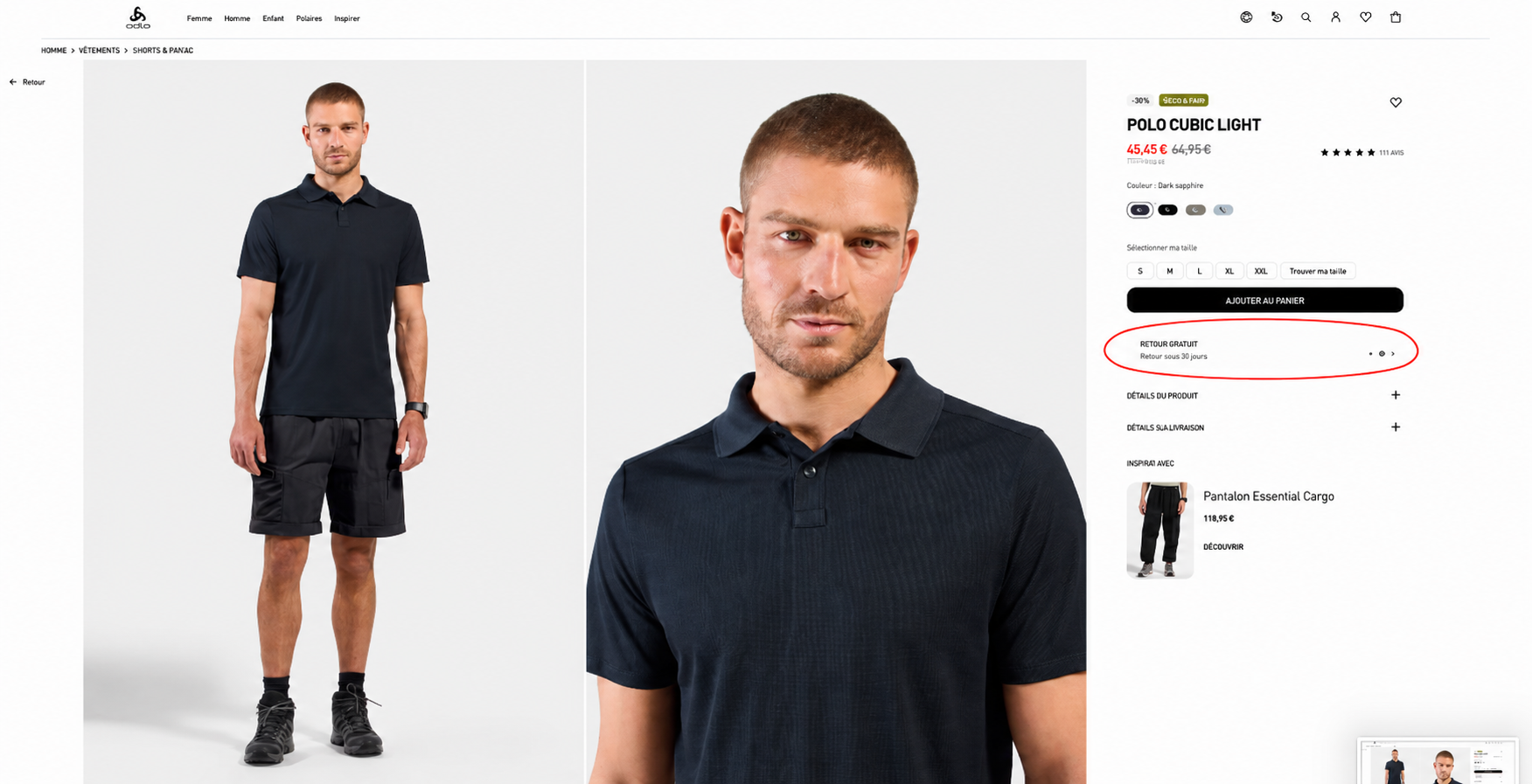
Vague phrasing like "returns possible under certain conditions" forces the consumer to hunt for information or accept a risk. Instead, retailers should clearly present:
- the return window;
- excluded products;
- any applicable fees;
- available drop-off methods;
- estimated refund timelines;
- the option to exchange an item;
- the rules applicable to promotions and international orders.
Transparency doesn't just reduce support requests. It can also prevent cart abandonment.
Free vs. paid returns: a more complex balance than it seems
Consumers remain highly sensitive to return costs. 54% state that paying fees is the primary factor that would discourage them from returning a product.
However, this does not mean that all returns must remain free without conditions.

When faced with a paid model, respondents prefer a moderate flat fee of around €2.50 covering the entire order, rather than a charge applied to each returned item.
The right answer depends on the context. Retailers can, for example, offer:
- free returns to a drop-off point, but paid returns from home;
- free exchanges, but paid refunds;
- free returns for loyalty program members;
- different rates based on the reason for the return;
- free in-store returns;
- a policy tailored to the basket value or the customer's historical behavior.
The goal is not to make returns complicated. A punitive policy risks lowering conversion rates. Instead, it is about offering multiple options, displaying their costs, and guiding consumers toward the most efficient paths.
Refunds have become a customer experience metric
Once the product is dropped off, the consumer does not consider the return process finished. They are waiting for their refund.
The study reveals two thresholds:
- a refund received within four days is perceived as faster than expected and creates a very positive experience;
- a delay of sixteen days is considered excessive and may discourage future purchases.
To reduce this wait time, retailers should track the following separately:
- the time between the request and the package drop-off;
- the return transit time;
- the time taken for receipt and inspection at the warehouse;
- the time between approval and the actual refund.
Without this breakdown, a total turnaround time of twelve days makes it impossible to identify whether the issue lies with the consumer, the carrier, the warehouse, or the financial process.
The last mile is also disrupting the lives of French consumers
Returns are only part of the problem. Even before deciding whether to keep or return a product, consumers have to successfully receive it.
One in three French people has taken time off work, changed their work schedule, or reorganized their day to wait for a delivery. Those affected spend an average of 3.8 hours waiting for their packages, and this situation impacts about 9% of their orders.
More concerningly, among consumers who have waited for a delivery, 87% report that at least one package arrived outside the scheduled window or did not arrive at all.

The issue goes beyond mere convenience. An inaccurate estimate can lead to:
- several hours lost;
- a disrupted workday;
- a canceled appointment;
- a missed delivery;
- a customer service inquiry;
- rejection of the brand or the delivery method offered.
The delivery promise should no longer be a generic window calculated at checkout. It must be updated after shipment based on real-time carrier events.
Package theft is changing delivery habits
22% of French consumers have experienced at least one package theft in the last twelve months.
Among the victims, 91% subsequently changed at least one habit:
- about two out of five now prefer lockers or pickup points;
- nearly a third favor services that offer reliable and accurate tracking information.
Choosing a carrier and delivery method is therefore not just an operational decision. It influences trust, conversion, and the likelihood of a customer ordering again.
Retailers must, in particular, allow consumers to choose between several solutions, communicate proactively, and make incidents visible before a ticket is even opened.
An economic imperative for the French market
These behaviors are taking place in a mature market.
In 2025, French e-commerce generated €196.4 billion in revenue, an increase of 7% over one year. Product sales grew by 4%, while services rose by 9%.
Every increase in volume mechanically increases:
- the number of parcels to track;
- the number of potential incidents;
- the volume of returns;
- the number of refunds to process;
- the products to inspect and restock.
Retailers who lack a unified view of delivery and returns therefore risk seeing their costs rise faster than their sales.
The urgency is also environmental and regulatory
Unnecessary returns represent more than just a transport cost. They lead to additional operations for collection, inspection, repackaging, storage, and sometimes destruction.
At the European level, textile consumption is the fourth-largest category of consumption with the greatest impact on the environment and climate, behind food, housing, and mobility.
The European Union generates approximately 12.6 million tonnes of textile waste each year. Clothing and footwear alone account for 5.2 million tonnes, or about 12 kg per person, while less than 1% of global textiles are recycled into new products.
In February 2026, the European Commission also adopted new measures to prevent the destruction of unsold clothing, accessories, and footwear.
The conclusion is clear: a returned product must be put back into circulation as quickly as possible. The longer it remains out of stock, the more its commercial value is likely to decline.
Retailer priorities in 2026
The numbers argue neither for eliminating returns nor for making them systematically free. They demand more precise management.
1. Reduce avoidable returns
Product data must address root causes upstream: consistent sizing, detailed measurements, realistic photos, customer reviews, and fit information.
2. Segment return policies
A return due to a defect, a size exchange, and repeat "buy-wear-return" behavior should not necessarily trigger the same rules.
3. Display conditions before checkout
The timeframe, cost, and return options must be visible without extra searching.
4. Diversify options
Drop-off points, lockers, in-store, home collection, exchanges, or store credit: the process must be tailored to the order, the country, and the reason.
5. Speed up refunds
Four days is a target for customer experience. Sixteen days is a threshold that should not be crossed.
6. Connect delivery, support, and returns
A late, damaged, or stolen delivery can trigger a return. Handling these steps in separate tools prevents understanding the real causes.
7. Measure recovered value
The return rate is not enough. Retailers must also track the time to restock, the exchange rate, the share of refunds converted into store credit, and the value lost on non-resalable products.
Which KPIs should you track?
Returns are no longer just a back-office issue
In 2026, French consumers expect more than just a functional return label. They want to know when their package will arrive, understand the policies before they buy, choose a convenient option, and get their money back quickly.
At the same time, a new generation views buying, trying on, and returning items as standard steps in a single experience.
Retailers cannot stop this transformation. They can, however, decide whether to be shaped by it or to lead it.
Brands that can reduce avoidable returns, detect costly behaviors, offer transparent policies, and get products back into circulation quickly will better protect their margins. They will also provide a more reliable experience for their customers.
In 2026, a sale no longer ends at checkout. Its profitability and ability to build loyalty are determined through delivery, returns, and refunds.
Shipup by ZigZag study methodology
Statistics explicitly cited as coming from the Shipup by ZigZag study are based on an online survey conducted by Sapio Research in May 2026 among 2,000 French consumers who shop online.
Frequently Asked Questions

In France, 18% of clothing bought online is returned, compared with 14% of footwear and 12% of electronics. Only 21% of consumers say their returns experience is always simple and reliable.
After a poor returns experience, 72% of consumers are less likely to buy from the same brand again. Clear return policies and fast refunds are therefore essential for maintaining customer loyalty.
Retailers should make return policies clearer, speed up refunds, and track the main reasons for returns. More accurate product information can also help reduce avoidable returns.
.jpeg)

Since 2023, Joseph Thurston has been responsible for content creation at Shipup by ZigZag. He designs high value-added and directly actionable resources for brands that sell online, in order to help them improve their post-purchase experience and transform delivery into a driver of loyalty and growth.
Join our webinar on September 9, 2026, to discover what 2,000 French consumers really expect from their delivery and return experience, and the levers you can pull to strengthen their loyalty.


.png)
